From Command to Conversation: Harnessing Collective Wisdom in Schools

I recently came across a thought-provoking blog by Nimish Lad on leadership as an attentional practice (link here- https://researcherteacher.home.blog/2025/08/17/leadership-as-an-attentional-practice/)  He writes:

“I am reminded of the phrase ‘you don’t know what you don’t know.’ While reflecting on your own practice is important, it may be more important to seek out the views of others to feedback on what you may not be paying enough attention to.”

That struck me. Leadership, especially in schools, is so often framed as an individual pursuit. We instinctively look for the expert, the decision-maker, the one with the answers. That’s what leaders are for, right?

Traditionally, leadership has been about evaluating the state of play, setting the direction and charting the course. But that model carries an inherent risk: important decisions get made in isolation. When just one or two people make a call, it is inevitably shaped by their assumptions, beliefs, values, and knowledge base.

“But they’re the experts,” you might say. “It’s their job to decide.” Perhaps. But as Chi, Glaser, and Farr (1988) remind us: ‘Experts excel mainly in their own domains.’ And even within those domains, expertise is not simply the product of innate talent or accumulated experience. As Ericsson & Ward (2007) define it expertise is: ‘Consistent, superior performance on key tasks, achieved through long-term, structured practice that transforms cognitive and physiological capabilities.’

That’s invaluable when specific knowledge is needed, but much less helpful when tackling complex, school-wide challenges that cut across multiple areas and perspectives. Take, for example, the challenge of improving literacy. While it might seem like the responsibility of the English Lead or Head of English alone, it also falls to the Geography Lead, the Science Lead, and even the Personal Development Lead to address this priority. In these cross-cutting areas, the expertise of each subject leader must be acknowledged and respected. At the same time, pooling this specialised knowledge allows teams to address broader priorities collaboratively, ensuring that decisions benefit from both deep expertise and the diverse perspectives needed for school-wide improvement.

This is where leadership must expand beyond the boundaries of individual expertise. It means stepping outside your own lens of what needs to be done to collaborate on solutions that serve both your area and wider improvement priorities.

Consider another example: senior leaders setting strategic priorities for the year ahead. Say a leader identifies Mathematics as a key area for development. That decision may well have come from deep analysis, looking at assessment data, classroom practice, and work scrutiny. But even then, it’s one person’s interpretation of that evidence, inevitably shaped by their biases, preferences, and prior experience. As Adam Grant puts it: ‘If knowledge is power, knowing what we don’t know is wisdom.’ (Grant, 2021)

In medicine, high-stakes, complex decision-making is often handled through multidisciplinary teams. These are groups of professionals from different specialties who come together to make decisions for a single patient. The structure of this model is worth examining:

  • Expertise is shared across disciplines to make more informed decisions.
  • The significance of the decision is explicitly acknowledged.
  • Key data and evidence are shared in advance, so everyone comes prepared.
  • Deliberate discussion considers risks, benefits, ethical implications, and patient preferences.
  • A clear decision is recorded, with a plan for review.

This approach has been shown to promote meaningful collaboration across disciplines and ultimately improve patient outcomes. A 2023 meta-analysis found that interprofessional learning within multidisciplinary teams (MDTs) led to a 23% reduction in treatment-related complications compared to standard care (Reeves et al., 2023).

Of course, none of this is to dismiss the importance of expertise, practicality, or accountability. There are moments when swift, decisive leadership is essential, and times when the responsibility cannot be shared. The buck still stops with the headteacher or senior leader. Nor is it realistic to suggest that schools, already stretched for time, can replicate the full structures of multidisciplinary teams in medicine. The point is not to abandon expertise or delay action, but to balance it: recognising where a leader’s specialist knowledge should guide the way, and where opening the conversation to others can surface blind spots, enrich perspectives, and ultimately lead to wiser decisions.

We’ve seen versions of this approach adopted in education already, in pupil progress meetings or in a pastoral context where multiple agencies come together to consider how best to support a pupil e.g. team around the family. But what if we used this model more intentionally not just for intervention, but to guide strategic decision making as leaders?

What if we made space for genuinely shared sense making, where knowledge is pooled, perspectives are challenged, and blind spots are surfaced before they become missteps? Perhaps leadership is less about having the answers, and more about creating the conditions for better questions and wiser decisions to emerge.

References

  • Chi, M. T. H., Glaser, R., & Farr, M. J. (1988). The nature of expertise. Hillsdale, NJ: Lawrence Erlbaum Associates.
  • Ericsson, K. A., & Ward, P. (2007). Capturing the naturally occurring superior performance of experts in the laboratory: Toward a science of expert and exceptional performance. Current Directions in Psychological Science, 16(6), 346–350. https://doi.org/10.1111/j.1467-8721.2007.00533.x
  • Grant, A. (2021). Think again: The power of knowing what you don’t know. Viking.
  • Reeves, S., Xyrichis, A., Zwarenstein, M., & et al. (2023). The effectiveness of interprofessional teams: A meta-analysis. Journal of Interprofessional Care, 37(2)
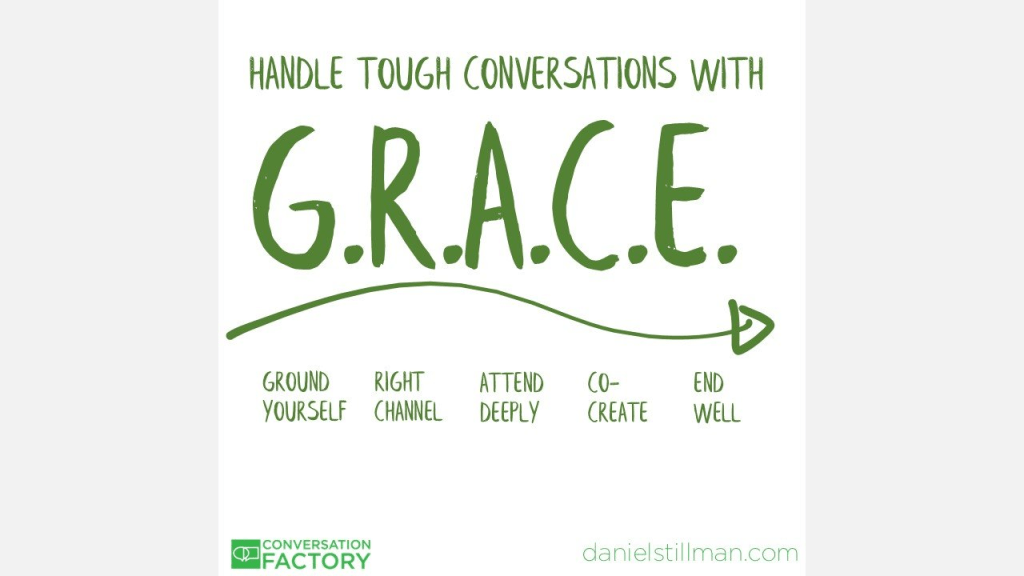
Disagreeing with Grace

Exercise can feel uncomfortable, unpleasant, and sometimes impossible. But as adults, we know avoiding it only leads to more problems later.

Now, let’s reframe that…

Disagreement can also feel uncomfortable, unpleasant and yes, sometimes impossible! However, while not every disagreement leads to positive outcomes, as school leaders, we recognise that avoiding honest conversations can often cost us far more in the long term: strained relationships, stagnation, and decisions made without the benefit of diverse perspectives.

Charlan Nemeth’s research into group dynamics and dissent, spanning from the 1970s to the 1990s, found that disagreement isn’t just helpful, it’s essential in many contexts. It encourages divergent thinking, improved idea generation and deeper analysis. 

Her work also revealed something important for team discussions in schools: authentic disagreement (genuinely held opposing views) is far more effective than someone simply ‘playing devil’s advocate.’ This relies on a level of psychological safety that teams may lack. The conditions for such candour must be deliberately built for colleagues to feel genuinely safe when speaking up.

Of course, speaking up, especially when you’re the dissenting voice, can be daunting. As Stone and Heen note in Thanks for the Feedback, receiving feedback of any kind sits at the intersection of our ‘drive to learn and longing for acceptance.’ The same is true for giving feedback, particularly when it goes against the grain of group consensus or tradition. However, without that all-important psychological safety, dissent often alienates rather than drives constructive dialogue. In short-it’s a delicate challenge.

In school settings, staff may hold back from challenging a popular opinion, not because they lack ideas, but because they worry about how they’ll be perceived. Yet Nemeth’s work shows that minority views, even when quiet, have a lingering impact. They shape decisions subtly and over time. This challenges the idea that power rests with a small group at the top, questioning hierarchical models that keep it there.

Power and the School Staffroom

In schools, as in any organisation, power dynamics shape who feels safe to speak and whose ideas carry weight.

The Social Alignment Theory of Power (Fast et al., 2002) explains that people adapt their behaviour depending on how much influence they believe they have. In a school setting, this might mean that a newly qualified teacher stays quiet in a meeting, while a long-serving SLT member speaks freely. These dynamics are often unspoken but deeply felt and as leaders, we must pay attention.

Three Responsibilities for School Leaders

  1. Notice the dynamics in your team.
    Who’s speaking? Who’s staying silent? And why? Pay attention to participation patterns in meetings and informal settings.
  2. Use your influence purposefully.
    Leadership isn’t just about being the loudest voice or final decision-maker. It’s about creating conditions where others can contribute confidently even (especially) when they disagree.
  3. Distribute power deliberately.
    Share responsibility. Rotate facilitation roles. Encourage staff to lead discussions or initiatives. Small structural changes can foster big shifts in confidence and agency.

A meta-analysis by Schaerer et al. (2020) found that while power can help individuals achieve their own goals, it often gets in the way of collective progress. Most school leaders won’t need academic data to recognise this; many have experienced the impact of a leader who dominates rather than fostering collaboration. 

From Theory to Practice: Disagreeing Well in Schools

We’ve established that:

  • Disagreement can be valuable in certain contexts.
  • How we disagree matters.
  • Power dynamics influence who feels free to disagree.

So how can school leaders build cultures where disagreement isn’t feared but welcomed?

1. Don’t Play Devil’s Advocate

Rather than performing opposition, express genuine thought. Try this:

“I think I disagree on this one…”

This phrasing balances humility, honesty, and specificity:

  • “I think” suggests openness.
  • “I disagree” is clear and respectful.
  • “On this one” signals that you’re not oppositional by nature, just thoughtful in this moment. 

2. Level the Playing Field in Team Meetings

It’s hard to remove hierarchy entirely but you can reduce its impact:

  • Ensure all voices are heard, not just the confident or senior ones.
  • Gently invite contributions from quieter team members.
  • Rotate who leads meetings or shares reflections.
  • Avoid symbolic power positions, like always sitting at the “top” of the table.

3. Pick a Lane and Be Honest About It

Leadership in schools involves an acknowledgement of power dynamics. Ask yourself:
Are you leading for your own advancement, or for something greater?
Progress for yourself and your community are not mutually exclusive. Effective school leadership requires balancing your own professional growth with the broader needs of the school, ensuring personal development strengthens collective progress. But how you balance those motivations and how they show up in your interactions matters deeply.

Practical Ways to Disagree with Grace in Education

Disagreeing with grace isn’t just about research or reflection. It’s about our daily practice in staffrooms, classrooms, and leadership conversations. Here are a few grounded reminders:

  1. Match the medium to the message.
    If you’re raising disagreement online or via email, be respectful. Tone is easily lost, and sarcasm rarely wins people over. 
  2. Stay open.
    Avoid gatekeeping. Resist the temptation of the echo chamber. Good ideas can come from anywhere: new staff, different departments, or external voices.
  3. Allow people space to grow.
    Give colleagues the grace to change their minds. We’re all learning. Assume good intent and leave room for development.
  4. Model politeness.
    It’s easy to overlook, but manners still matter. Courtesy builds trust and trust builds better teams.

Disagreeing in school leadership isn’t always comfortable, but it’s necessary. Like exercise, the discomfort is part of the growth. Avoiding it doesn’t make it go away. It just makes the problems grow in silence. Because in leadership, unchecked power can quickly turn into pique and that can quietly undermine the very purpose of what we’re here to do: lead learning, lead people, and lead with integrity.

The Importance of Language: Framing Professional Conversations

Finally, it’s worth reflecting on the language we use around conflict and conversation. The word ‘disagreement’ can sometimes carry connotations of opposition or conflict, which might unintentionally discourage open dialogue. Instead, terms like ‘debate,’ ‘professional discourse,’ or ‘collaborative inquiry’ might better capture the spirit of constructive and respectful exploration of ideas that we want to cultivate in education. Debate is a skill. It is rooted in respect, evidence, and active listening that can be developed and valued across the sector. By framing our conversations this way, we encourage a culture where diverse ideas are rigorously but respectfully examined, supporting continuous learning and fostering a culture of growth, not division.

‘Why are we doing this anyway?’ A framework for establishing, evaluating and exploring our purpose.

Purpose is the intentional and guiding principle that connects what we do to why it matters.

Greek philosophers often discussed the concept of ‘purpose’ using the term ‘telos’ (τέλος) which means end goal or purpose. Aristotle articulated this through his theory of four causes: material, formal, efficient and final. The final purpose being the ultimate end goal e.g. an acorn becoming an oak tree. Plato believed the highest purpose of human life was the pursuit of truth and wisdom. And for the Stoics, purpose was all about living in alignment with nature and reason.

Purpose in the context of organisations and more specifically in the realm of school improvement is also not a new concept. Very few school leaders would argue against the need for clarity of purpose in their improvement efforts and we already see the word ‘purpose’ in multiple ways in our schools. For example:

-purpose of study in National Curriculum guidance

-purpose statements for trusts or individual schools

-purpose of improvement initiatives or strategic moves

I’ve been thinking a lot about purpose recently. Personally, in a more existential way and professionally in a bid to consider the more practical ways educational leaders can work with the knotty, complex and yet, beautifully simple ‘texture’ of purpose as a concept. Simon Sinek’s more recent work ‘Start with Why’ has popularised a long-held tradition of leaders deeply considering the ‘why’ of what they do, with a focus on accurately articulating and rooting their work in this ‘why’. Dr Houman Hourani (Harvard Graduate School of Education), talks about how those we lead may well ask the question ‘why do we need to do this?’ and how this is often interpreted as whining or expected discontent in the face of change. He argues however that we as leaders must be able to confidently answer this question and in his words ‘move more seamlessly between purpose and task, task and purpose.’

My thinking on this topic has led me to put together the beginnings of a framework for leaders at all levels to more practically consider their purpose through meaningful dialogue. Whether they are doing the exciting work of establishing a purpose or whether they are coming back to their purpose and evaluating the extent to which it is being fulfilled, I hope this framework serves as a useful way to structure conversations. Below is my ‘I CAN’ framework for exploring purpose. The framework might be applied in: school-wide conversations about orientation and direction of travel, departmental meetings more tightly rooted in the purpose of individual subjects or strategic conversations about the purpose of change initiatives.

Please note that the framework is in it’s first draft and I’m keen to get the conversation going about the ways it can be refined, to become a practical reflective tool for school leaders. This time of the year felt like an apt time to share the framework in the spirit of collaboration and I do hope it sees multiple iterations in the coming weeks and months, reflective of practitioners who are engaging in the important business of exploring purpose in our schools. (PDF below)

From Research to Reality: Concept Futility to Concept Utility

Advances in cognitive science, psychology, and neuroscience over the past decade have deepened our understanding of how pupils learn. For experienced teachers, this has often affirmed intuitive practices. For newer professionals, it has helped shape the contours of their initial teacher training. Either way, one thing is clear: these insights have not only enriched the teaching profession but, when applied well, have tangibly improved learning outcomes for pupils. However, between the research findings and the micro-decisions we make in the classroom lies a vital space, which is shaped by the quality of professional development (PD), how we interpret and apply our learning, and the insights we develop through lived practice.

In this blog, I share some reflections from leading professional development at school and trust level, and from observing approaches across the sector. My focus is on how we can move from concept futility—terms that are named but poorly understood—to concept utility—ideas that are purposeful, applied effectively, and make a real difference in the classroom.

Language: Building Bridges, Not Barriers

Language has the power to include or exclude. Over time, I’ve learned that the way we introduce and use educational terminology can either open up understanding or shut it down. We should strive to meet colleagues where they are, using language to invite them into learning, not to position ourselves as gatekeepers of knowledge.

Technical terms like metacognition, meta-analysis, or randomised controlled trial are important, but without clear explanations or accessible shorthand, they can feel abstract or intimidating. Offering simple, meaningful shorthand terms supports understanding and provides a shared language for CPD conversations. Over time, this fosters depth of learning and continued engagement.

When designing PD, it’s worth reflecting on the terms we use and how we explain them. Language either amplifies or diminishes understanding and our role as leaders of learning is to make complex ideas more understandable, not less.

Purpose BEFORE Process

One of the most impactful shifts I’ve seen in teacher development is starting with purpose before delving into process. Take checking for understanding, for example. When we begin by exploring why this practice matters and how it supports responsive teaching and formative assessment, we set the stage for deeper learning. Teachers then see the point of various strategies, rather than viewing them as isolated techniques.

Too often, strategies like using mini whiteboards are introduced as ends in themselves. This risks reducing powerful pedagogical tools to performative routines executed carelessly. Mini whiteboards, when framed as one of many ways to check for understanding, become part of a broader repertoire. We need to spend time unpacking both the purpose behind the strategy, the alternatives that exist, and which tool works best in different situations. Don’t get me wrong: having a handy step-by-step guide on how a teaching technique plays out is illuminating. However in my experience, it’s unlikely to have maximal impact unless the teacher deeply understands it’s purpose and in what situations it actually makes a difference to learning.

Sequencing PD to begin with purpose, build shared understanding, and only then zoom into specific processes leads to stronger, more reflective practice.

The Role of Naturalistic Decision-Making and Coaching

In recent years, I’ve become increasingly interested in Gary Klein’s work on Naturalistic Decision Making (NDM). Unlike traditional decision-making models based on rational choice and ideal conditions, NDM examines how experts make decisions in real-world, high-pressure environments…sound familiar?

In their 1993 research, Orasanu and Connolly identified key features of such environments:

  • Ill-structured problems
  • Uncertain, dynamic contexts
  • Shifting or competing goals
  • Time stress
  • High stakes
  • Multiple players
  • Organisational constraints

These features are present in nearly every classroom, every day. Teachers are constantly navigating shifting dynamics and making rapid decisions based on what they observe. Recognising this highlights just how complex and skilled teaching truly is.

So, what does this mean for PD? Coaching, when done well, provides a vital opportunity for teachers to reflect on the why behind their decisions. By revisiting lessons with a focus on their in-the-moment choices, teachers can develop greater awareness of what influenced their actions, what impact they had, and how to build on them. This doesn’t mean adding more theory for its own sake. It means making the invisible work of teaching visible, discussable, and improvable.

From Knowing to Knowing How

The challenge and opportunity lie in how we translate research and theory into real decisions in living, breathing classrooms. When professional development is purpose-led, language-sensitive, and rooted in the realities of classroom complexity, it does more than inform…it empowers and promotes teacher agency.

As educators, we are not just applying other people’s research. We are building a professional knowledge base of our own, refined through practice, coaching, and deep reflection. In that middle space between research and classroom reality, there is immense potential. It’s where theory becomes action and where action becomes learning that lasts.

The Leadership Development Challenge- it’s time to Get Real

As a leader who has spent much of the last decade designing, implementing and refining curricular across different contexts and on different scales, I have been deeply encouraged by the tone and tenor of the recent curriculum and assessment review which we have seen unfold over the past few months. The way in which collective knowledge is being pooled, the transparency of the process itself and the way in which findings have emerged and been communicated are all markers of great change management by truly great leaders within their own right.

Recently however, this reflection prompted a thought…much of the quality of curricular evolution of any kind, is determined by the manner in which it is navigated, implemented, refined and ultimately, led. And this thought led me to another…without the necessary skill, knowledge and actionable expertise, leaders are left with potentially shifting sands, the requirement for change and little by way of professional support, guidance and development to help them achieve this successfully.

Educational leaders have an incredibly difficult challenge on their hands when it comes to developing and strengthening their curriculum offers:

  1. the work they do is never done and therefore can be challenging to frame in a ‘get it done’ ‘to-do-list’ culture.
  2. the work is nestled in a complex, relational ecosystem which, if unbalanced, compromises the very core business of learning and teaching and the longevity of implementation
  3. they carry out this work, largely in isolation and when networks do exist, the culture (unwittingly and even in the most well-intentioned places!) is sometimes one of competition, rather than collaboration

And this isn’t limited to curriculum development! In every domain of leadership, these barriers exist. I would argue that in the wake of less readily funded NPQs and an undeniable level of variability in leadership development entitlement for school leaders nationally, there is a vacuum that must be filled.

I’ve pondered over the potential solution to this challenge deeply over the past few years. Beyond the knowledge contained in the NPQs how best can leaders be supported to:

-move from domain specific knowledge to effective professional practice

-supplement their domain specific knowledge with the knowledge of how to achieve the right conditions within the teams they lead (as a necessary prerequisite to sustained school improvement)

-tackle the recruitment and retention crisis upstream by shifting to a dual focus on the ‘what’ and the ‘how’ of school improvement

If you’ve read up to this point in the blog, I’m sorry to say I don’t yet have an answer. But a few colleagues of mine (the formidable duo Sarah Cottinghatt and Nimish Lad) have been thinking deeply about this, with the support of our dear mentor, Oli Caviglioli.

We’ve been fascinated by the notion of ‘Naturalistic Decision Making’ (Klein 2014) and spent many hours considering how we help leaders ‘on the court’ and ‘in the moment’ with real life situations that happen in real schools (that quite often we don’t really discuss widely for many reasons!) Not in vignettes or scenarios that avoid the messy stuff of school leadership. In ones that capture the real nuance and allow leaders to discuss solutions, collectively, in a low stakes way.

That’s when we came up with the idea for Get Real Leadership Hub. A community-led platform, where realistic school scenarios are released fortnightly and educational leaders have a chance to respectfully debate, discuss and sensemake. We will share useful links, reading and expert opinions related to the scenario and empower leaders to think deeply about implementation, in a way they might not otherwise be able to. It’s all free, it’s not overly shiny, and it’s generated by the collective knowledge of leaders in the sector. There are also no ‘right answers’ to the scenario. It’s not about getting to the answer, it’s about how you find the solution (hat tip to all my maths teachers out there!)

It’s certainly not the finished product but we work on a simple premise:

‘Do the best you can until you know better. Then when you know better, do better’ Maya Angelou.

And even if one leader in the sector benefits from GetReal, we will consider it a job well done. Please follow us on X and Bluesky and be part of the solution, the conversation and the community. It’s time to Get Real.

‘The Rippling Effect’- what ripples do you want to create this academic year?

Irvin Yalom, a professor of psychiatry at Stanford University, writes about ‘the rippling effect’ in his book Staring at the Sun. He refers to the rippling effect as: ‘the fact that each of us creates—often without our conscious intent or knowledge—concentric circles of influence that may affect others for years, even generations.  That is, the effect we have on other people is in turn passed on to others, much as the ripples in a pond go on and on until they’re no longer visible but continuing at a nano level.’

We’ve all likely felt the ripple effect of a leader who we’ve been led by. An intangible quality, manner or way of being that made us feel seen, heard and valued and more tangibly, the domain-specific expertise that reshaped the way we thought about something, in true service of the pupils we teach. An ability to navigate complexity intelligently, with measure and deep consideration of context. Ways of thinking and being that are robust, reasonably consistent and that provide an unspoken ‘drumbeat’ of interaction and behaviour, often leaving a ‘ripple’ of frameworks for thinking and a deep sense of psychological safety. I write this description with some hesitation and a passionate desire to avoid perpetuating the idea of ‘hero leaders’ who are all-seeing, all-knowing and infallible. (Spoiler alert-they don’t exist.) It’s fair to say this is an unhelpful contribution to the leadership development space and causes more problems than it solves. As Mary Myatt so aptly puts it in her recent blogpost, ‘no one wants to feel like a muppet’ and such a high-stakes bar, with little room for failure, is both unrealistic and unlikely to develop self-compassionate leaders; something which is arguably as important, as developing great leaders. However, great leaders exist! So the question remains…

How do we support leaders to get EVEN better?

I’ve been endlessly curious about how leaders can best be supported and developed in their roles. But there are some enduring questions about what makes a great educational leader that are left unanswered. This makes it very difficult to hypothesise sure-fire ways to develop excellent leaders, outside of broad approaches that are likely helpful. I wrote ‘Building Culture’ in an attempt to consider the strands of school culture that leaders might be able to focus on, to strengthen the impact of their leadership and grow thriving teams. But the question ‘how do we support leaders to get EVEN better?’ persists. I am determined to make some headway in finding answers to this question and particularly keen to learn from the wonderful leaders who do this important (and incredibly challenging!) work so well, day-in, day-out…more to come on this below!

Reflections for a New Year

But for now, ahead of a new school year, I’d like to consider ‘the rippling effect’. To do this, I pose some provocations for your reflection:

  1. What ripples do you want to create this academic year for your pupils?
  2. What ripples do you want to create this academic year for those you lead?
  3. What do YOU need as a leader to create those ripples?
  4. What might turn those ripples into a stone that just sinks?
  5. How might you mitigate against this?

How do we make a ripple?

When we zoom in and really think about what creates a ripple, we recognise it involves:

  • an initial disturbance that impacts the water
  • delicate concentric circles that slowly scale up
  • close to the water, it’s just water. Step out and we see the beauty of the water rippling out, as well as the longevity of the ripple.

As leaders in terms of school improvement/development then, we might think about:

  • whether we truly need this disturbance to the system or whether it’s best to let the ‘water’ settle
  • how we might ensure that we delicately gauge conditions in our teams and refine our support, professional learning and challenge in light of this.
  • how we might step away from our system to be able to get an accurate view of the ‘big picture’

By considering what ripples we want to create, we can be more intentional and deliberate about not only WHAT we are doing but HOW we do it.

Let’s circle back to the question- ‘how do we support leaders to get even better?’ We know great educational leaders exist..So, by figuring out how they lead, what helps/hinders their thinking and decision making and what they DO to create teams that stay, we can get closer to answering this all important question. I am keen to speak to as MANY educational leaders as possible to discuss the thinking, practicalities, complexity and joy that goes into leading an educational setting. In doing so, I hope to tease out some of the common themes and ideas, in order to create content and tools to support educational leaders on the ground. If you’re interested in being involved, drop me a message on my website, Twitter, Bluesky or LinkedIn. Alternatively, if you’re short on time, please consider responding to my MS Forms survey which I’ll share in the next few weeks. Let’s make some ripples!

In the meantime, I wish you all a happy new academic year and look forward to seeing the many positive ripples to come, across the sector.

Communication- let’s talk about it

As leaders, we spend a lot of time communicating. Communicating our thoughts. Communicating our feedback. Communicating our relative position on a charted course. Communicating makes up so much of what we do. As school leaders, we work in complex environments that are demanding, unrelenting and require constant communication. Yet, there is little, or no training provided to school leaders on how to get this aspect of leadership right. Instead, we form representations of great communication in our mind; an amalgamation of great and not so great communicators that we’ve experienced and rely on these to help us craft our messages.

The challenge for us leaders is that we often adopt ‘approaches’ to communication that become a trademark of our ways of working. Why might this be problematic? If our mental representation of great communication is ill-informed or if we don’t intentionally set norms around the way we communicate in our teams, we may have an unhelpful reputation on our hands…Introducing…

The truth teller: the leader who tells the excruciating truth with very direct use of language every single time. You know where you stand but you’re not left standing…you’re left crushed…into a former shadow of your professional self, questioning your value as a human being. Psychological safety might be easier to achieve with this leader at the helm because they are so transparent, but it also might be harder because their direct-ness is intimidating and shuts others down.

The nice leader: this nice leader is beloved by all. They are easy to talk to and fun to be around, but they prize being liked over everything else. Because of this, you’re not quite sure that what you’re getting is an accurate view of what they truly think. Trust might be more easily achieved with this leader from a relational standpoint but less so from a competency-standpoint. Do I trust this leader to point out my strengths? YES. Do I trust them to tell me the truth about the real state of play? Not so much.

The dresser up of the truth: this leader uses beautiful and flowery language to dress things up. It sounds kind of wonderful but a dark feeling in the pit of your stomach tells you it’s anything but wonderful. Communication may not seem particularly authentic because it’s had so much ‘work done to it’. Once this happens a few times and we recognise this as a pattern of communication, we may shut down entirely for future interactions.

The overwhelmed leader: this leader is deeply caring but every conversation appears to evoke a sense of panic in them which in turn evokes panic in you. You are ultra-aware of this leader’s workload and therefore upward empathy is well-established. The downside of this, is that people tend to avoid conversations with them altogether, as to not stress them out.

The four above caricatures of leaders are just that- fairly exaggerated caricatures from the point of view of colleagues in these leaders’ teams. There is also no judgement of these caricatures- it’s likely that as leaders, we’ve all played these parts at some point (I know I have!!). But they do remind us of a few important things:

  1. Choices we make around the way we communicate come with pros and cons. There’s never a ‘right’ way to do it and context is everything. We may, in certain situations, for example NEED to be ‘the truth teller’. It’s not clear-cut, it’s incredibly nuanced and there’s no ‘educational best bets’ to lean back on around communication- much of this relies on instinct and having experienced or seen good models of communication before.
  2. Choices we make around how we communicate can very easily morph into these caricature trademarks, which can inadvertently impact our leadership efforts. Being more aware of how we’re communicating and the impact this has on those we lead, is our best bet.
  3. Recognising that our intentions may be at odds with how our message or story lands for the recipient is crucial.

What communication?

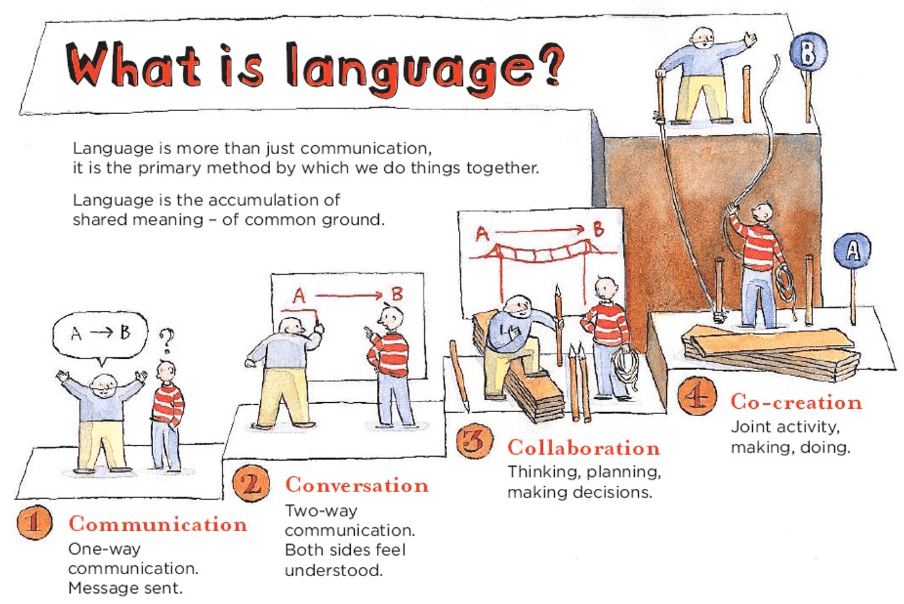
So how might leaders support themselves in crafting their message? To begin with it’s important to boil it down to, as Dave Gray calls it, ‘the primary method by which we do things together’- language. What can language be used for?

  1. Communication
  2. Conversation
  3. Collaboration
  4. Co-creation

By first, identifying the purpose of what we’re doing together, we can begin to consider the ways in which we might use language to fulfil these purposes.

Language for Communication

Language for collaboration will look markedly different to language for co-creation. Language for collaboration, for example, will be far more tentative, flexible, and fluid. A specific example? Modal verbs will be far more present in our vernacular. ‘This might be the way forward…’ ‘We may need to explore the different approaches further.’

Language for communication, where a message needs to be transmitted from A-B will look slightly different- it will be direct, with imperative verbs, economy of language and crisp clarity. Short prose, with key headlines work very well for this type of communication and in the best-case scenario, there is very little room for interpretation. (NB- also worth noting the visual above and the clarity it brings to this conceptualisation, as a means of communicating an idea).

Language choices (down to the word) can make an incredible difference to the way a message is interpreted. For example, saying ‘I need this from you by next Tuesday…’ is experienced entirely different to ‘We need to achieve this by next Tuesday. The expectation is that…’ When scripting an email, it feels doable for us to consider our language choices carefully, but this becomes much trickier in spontaneous communication e.g. a conversation. During these types of communication, leaders have to be far more responsive and rely on their instincts to recognise the ‘mood’ of the conversation. Again, there isn’t necessarily a formula for getting these spontaneous conversations ‘right’, but it may be useful to be aware of the below model, developed by Padensky (1995). This hot cross bun model, typically used in the context of clinical psychology, very helpfully highlights the interplay between individuals’ thoughts, feelings, behaviours, and physical feelings. Recognising the relationship between these, can potentially support leaders in truly unearthing people’s perspectives enabling them to truly see and hear those they lead. As Peter Drucker, quite aptly puts it: ‘The most important thing in communication is to hear what isn’t being said’ Peter Drucker

Communication for Professional Learning

Effective communication is also essential when designing and delivering CPD of any kind. Matt Abrahams, lecturer on communication at Stanford Graduate School of Business, offers some useful guidance on how best we can communicate during any form of presentation. He encourages speakers to:

  1. Help their audience feel comfortable by mastering one’s own anxiety. How? By recognising it, acknowledging it, and accepting that it’s something we ALL feel. This alone can minimise the impact that this undoubtedly has on us when addressing a room.
  2. Reframing your view of things by moving away from ‘trying to get it right’ towards ‘having a conversation’. By doing so, we shift the dynamic in the room away from transmission of information to an interactive conversation. From didactic to dialogic. From being told to collectively learning.
  3.  By opening with a question to invite the audience into the ‘conversation’.
  4. Abrahams suggests structuring your presentation as an answer to a list of questions to again, move towards the dialogic.
  5. He also encourages speakers to be hyper-vigilant about the language that they use and to keep it simple. He encourages speakers to opt for simple language that unites, rather than language that creates a distance between the speaker and audience.

When crafting professional learning, we therefore may want to consider the following questions:

  1. What will my audience know at the end of the session that they didn’t before? Limit this to 1-3 things as not to cognitively overload our audience.
  2. What terms will I use? When will I define those terms?
  3. Why is this important for them to know? How will it impact them day-to-day?
  4. How will my audience feel when they leave this session?
  5. How will I involve my audience in the conversation?

Communication, like school culture, is messy, knotty, and heavily context considerate. It varies from person-to-person and situation-to-situation. Because of that, it can sometimes be scary to focus on this, amongst the billion other things leaders need to focus on. I would argue however, that it’s in the very small interactions of a few sentences or words, that trust and psychological safety are built. If we as leaders can accept that we won’t always get it right and be at peace with this, we can perhaps open up a conversation about what good communication does look like in our contexts. Perhaps by creating norms with other leaders, we can create a safe, consistent drumbeat of interaction within our teams, laying the foundation for a work environment that feels calm and consistent, where people feel truly seen and heard and where there is a deep and enduring sense of community.

Link for further exploration:

Kintsugi

A few days ago I attended a kintsugi class in London with a dear friend (finished product pictured above). Kintsugi’s literal translation is ‘gold joinery’ and is the process of mending broken pottery with gold, thus celebrating the cracks as beautiful imperfections, rather than shameful flaws. I sat entirely engrossed for two hours, concentrating deeply on the joins and applying the gold to the cracks in the ceramic. A beautiful, mindful craft. But as I travelled home, I started thinking about our education system and the cracks that have emerged over the years. It’s first important to acknowledge that these ‘cracks’ have formed due to a perfect storm of things at play and that it’s somewhat inconsequential to play a blame game. Yes, history can teach us how we came to be and plays an important role in understanding the nature of education’s current state of being. But dwell for too long and we find ourselves entrenched in a situation where further energy and time is lost to finger pointing; time and energy which would be much better spent in finding solutions to the systemic issues that will ultimately shape a generation’s educational experience. If we can adopt a hopeful and optimistic disposition to the system that we currently operate in and focus on forging a stronger path forward, we set the tone for innovation, collaboration and rethinking. Much like the gold used to forge the broken pieces of ceramic back together, we can begin to identify strong ‘compounds’ to repair those cracks, strengthen our system and create beautiful new beginnings. It sounds idealistic at first and somewhat naive but every innovation begins with challenge. Reframing in this way, can sustain our purpose, curiosity and collective thinking.

The real question is: what is the gold? Here are a few things I hypothesise it might be.

1. Research-informed practice and design: by leaning into the research and allowing the research, among others things, to inform our thinking, we maximise the chances of implementation success. Rather than innovating in ways that are potentially problematic or may not stand the ‘Year 9 rainy Tuesday afternoon’ test, we mindfully implement from an informed position. An important caveat- we must recognise that research covers all manner of things (including craft expertise of the teacher who’s been in the classroom for 20 years- our true golden practitioners!)

2. Collaboration and system leadership: seeing any problem within the system as OUR collective problem is important. We stop working in silos and start working together (across groups) for a common purpose. Collaboration over competition.The more we collaborate, the larger pool of knowledge and ideas we possess. And knowledge is power.

3. Culture and conditions: of course I would say this but getting the conditions in our school teams right is key. Without these, we’re left with high mobility in our staff teams, poor retention rates and a profession that looks increasingly unattractive to graduates. This isn’t just about stabilising our existing work force, it’s about succession planning for our future workforce. Getting the conditions rights is hard to do and leaders need to be well-supported both intellectually and emotionally to get this complex work right. Research on the best bets for leaders is virtually non-existent- this needs to change.

4. CPD: for new teachers, for seasoned pros, for leaders…for EVERYONE. Well-designed, intentional learning for all, needs to be an entitlement if we’re asking colleagues to grapple with very complex work littered with wicked problems(see below for link on ‘wicked problems’) And linking to number three, seniors leaders in particular I think, need access to training that gives them the knowledge AND practical tools to manage a job that straddles multiple domains. Leadership isn’t a passport to skip CPD, it’s a responsibility that requires continuous CPD.

It’s also important to note that there’s lots of existing gold in the system, and where that exists, whether it’s models of great practice or tried and tested innovative approaches, we must actively seek these out and spotlight these to further augment our understanding of how we can practically achieve excellence (that can actually be sustained over time!) Shout out to a few golden nugget practitioners/approaches I’ve come across this year below.

Every system has flaws. It’s important to recognise these but even more important to approach them with optimism, hope and the belief that there’s a better way forward.

Here’s to 2024! May it bring you joy, laughter and lots of learning.

https://www.cambridgeassessment.org.uk/blogs/complexity-wicked-problems/

Shout outs-

-Having watched Thahmina Begum in action this year, I would highly recommend going to check out the work being done at Forest Gate Community Schools. The detail to attention, the culture building and the relentless drive to keep learning and teaching at the forefront of all things is quite spectacular.

-The work Steve Rollett has led over this past year to uncover to explore theory and practice of school improvement within trusts has been a true source of inspiration and learning for me. A real-life example of collaboration and rethinking at its best. More info here- https://cstuk.org.uk/knowledge/inquiry-on-sector-led-trust-improvement

-I was really impressed with the work of Ed Vainker and his team having visited Reach Academy. Learning more about the ‘Cradle to Career’ programme reminded me of the true scope of our work as educators and reinforced the importance of community in school and societal improvement.

-Slightly biased on this one but the work of Avanti Schools in developing not only educational excellence but also character formation and spiritual insight, has made me think hard about the purpose of education and kept me entirely engrossed and inspired, as I’ve navigated my first year as School Improvement Lead within the trust. The fact that yoga and meditation (practical tools for wellbeing and wellness) are tools that our pupils leave with after their time at Avanti, is both unique and expands the conventional idea of what ‘school’ has to offer.

-Heena Dave and Prof Leigh Hoath and their work in establishing and growing the work of CAPE (climate adapted pathways for education) is remarkable. They have (whilst being in full-time work!!) brought together leaders, teachers and experts to create a growing knowledge base around the best bets in educating young people about climate change. Their values-led approach and collaborative nature have added a cherry on top of this success story. Read an article by Heena Dave and Patron of CAPE, Mary Myatt here- https://schoolsweek.co.uk/the-climate-crisis-requires-a-thoughtful-curriculum-response/

Spotlight on Great Practice- Hidden in Plain Light

A few weeks ago, I had the pleasure of going to see Dylan Wiliam speak at UCL (not that I’ve mentioned it too many times or anything!) This story is however, not about Dylan W. I was sat mingling with the other educators ahead of his talk, when I got into conversation with a lovely lady who’s involved in professional training. She mentioned that she had attended a conference that week and preceded to tell me about a particular speaker at the conference. ‘I’m in my 60s and she made me feel like I could do anything. I used to think that the number of years of experience you had determined how good you were at your job but not anymore…’ She spoke incredibly highly of this speaker, and I was curious to know more. We continued to talk, only for me to discover that by chance I had visited this leaders’ school earlier that week and had the pleasure of hearing from her and being equally inspired by her journey. We were both referring to Thahmina Begum, Executive Headteacher at Forest Gate Community School.

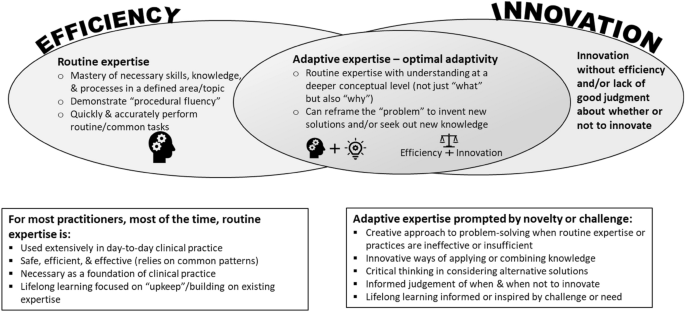
The more I’ve researched, read and explored school leadership and culture, the more inclined I am to avoid narratives of ‘hero leadership’ but I am compelled to tell this story, mostly because I do think there is some value to be derived from looking at the conditions that leaders cultivate and considering what’s contributed to these conditions being instilled in our schools. It’s such a complex and messy business, that when colleagues within the sector are getting it right, I think it’s important we consider why to support the development of our own mental models and adaptive expertise (see below for a useful diagram on the role of adaptive expertise in from the field of Medicine, concerning clinical educators-Cupido, N., Ross, S., Lawrence, K. et al) .I am also a strong advocate of collaborative professional growth so that we can collectively refine our thinking around what ‘best practice’ really means, especially in leadership- a field where research on ‘best bets’ is relatively thin on the ground.

Erhard refers to the distinction between being ‘on the court’ and ‘in the stands’- it is here that I think we can draw value and insight into great leadership- from learning from those who are having impact ‘on the court’.

I want to begin with the end…the culture of continuous improvement that is evidently woven into the tapestry of the school’s very being. I think a true culture of continuous improvement is a lot harder to achieve than one thinks. It goes beyond ‘wanting’ to continuously improve and accepting the importance of continuously improving. And for a leader, this can present a very difficult tension. On the one hand, leaders are presumably hired into leadership role because of their competency, knowledge and skill sets and therefore need to present with a reliability that assures those they lead. On the other hand, they must model how necessary ‘learning’ is at all levels in order to cultivate an authentic and deep culture of continuous improvement. This is one of the key qualities of Thahmina’s that shone through as she discussed the schools’ approach to continuous professional development.

She models continuous learning whilst maintaining a competent and assured position.

This is achieved in a number of ways:

  • A commitment to evidence-informed approaches: by being a leader who is constantly engaged with the ‘evidence’, she is able to remover her own self-expression and ‘position’ from the equation. She levels the playing field between herself and those she leads by allowing a focus on the knotty problems of teaching and learning, rather than focusing attention on her own perspective or relative position. Julia Dhar, world debating champion, refers to the idea of separating identity from ideas and how this enables people to more easily access an idea or notion that they can then engage with. It’s not Thahmina’s idea…it’s her professional judgement and context-considerate perspective, guided by the evidence and what educational research tells us are the best bets.
  • She engages with the sector in order to share the school’s approaches. In doing so, she vulnerably allows for ‘critical feedback’ knowing that it may challenge her thinking but will ultimately strengthen the approach itself and thus implementation within the school.
  • She speaks with authority and assurance, knowing her position is guided by evidence-informed practiced.

She leads with humility and challenges traditional orthodoxies of ‘leadership’.

Beyond her approach in cultivating a culture of continuous improvement, there was one particular thing that struck me (and evidently the lady I struck up a conversation with at the UCL lecture)- her humility. I write this with some hesitation, knowing that humility is a word often thrown around in the leadership sphere…again associated with the hero leadership narrative…and very difficult to pin down!

A Headteacher at 31 and an Executive Headteacher at the age of 35, Thahmina embodies a spirit of humility (not least because her response to this blog was ‘I have lots of brilliant people that make me look good’) and unrelenting high standards which although are opposite in nature, compliment one another and are manifested through:

  • An acknowledgement of the role of both intelligent and compassionate accountability in school improvement: on the day we visited Thahmina and her CEO spoke about the ‘soft conversations about what was going wrong’.
  • The ability to flip the narrative around teaching and learning so it’s approached with the same urgency and importance as safeguarding- again this is done with a humble purpose and spirit of service with regards to the pupils they work with. It come backs to their ‘why’ and their ability to ensure that it’s fulfilled through a common and shared sense of understanding.
  • Clarity about the greater purpose that goes beyond oneself.

An analogy that might clarify this last point is that of the popular gameshow ‘CatchPhrase’. Thahmina sees the bigger picture and communicates this with clarity so that those she leads are able to see their role and part in contributing to that ‘bigger picture’.

Thahmina challenges traditional leadership orthodoxies. She is proof that your age doesn’t constrain your ability to go after the necessary learning experiences to have the competency, confidence, and compassion to lead well.  A challenge that I have faced throughout my career, she reminded me that it is not our years of service that define our expertise (although arguably this plays a part) but the substance and quality of our practice and our openness to learning.

I’d like to conclude this blog with a quote from someone whose experience as a Senior Leader has been enriched by Thahmina’s leadership. I do so with the intention to uncover the ‘lived experience’ of those who have worked with her day-in, day-out, as to highlight the impact this remarkable educator has had not only on the outcomes of the young people her schools serve, but also on the colleagues she has led.

‘As my line manager when I was a senior leader at FGCS and then as my Headteacher, Thahmina supported me and challenged me in equal measure. I felt seen, valued and cared for by Thahmina as she gave me the autonomy to run with my ideas, particularly around leading English and T&L, and then challenged me to think differently. Thahmina taught me what effective line management is and really understood my strengths and helped me to close the gaps in my leadership skills. For example, I always struggled to hold people to account and Thahmina taught me about Radical Candour which really empowered me as a new senior leader.
What has been really powerful for me has been seeing Thahmina, as a hijab wearing woman, lead so effectively for the students. I never thought I would want to be a Headteacher but seeing Thahmina lead as a Executive Headteacher inspires me and I hope to be like her one day.’

These stories unveil the amazing work that goes on in corridors and classrooms up and down the country and remind us of what a joy it is to work in the profession amongst talented practitioners and amazing pupils.

Dan Willingham refers to the idea of stories being ‘psychologically privileged’ and off the back of the publication of ‘Building Culture’ I hope to continue to tell the stories of wonderful leaders in schools (who I have the privilege of learning from and speaking with) who are making a difference where it matters- in classrooms and staffrooms. And I would encourage you to share and reflect on these stories too, so that we can collectively shift the negative rhetoric that sometimes casts a shadow amongst our beautiful, vibrant profession.

Implementation Efforts- maximising the success of the landing 

I was recently flying on a plane to Dubrovnik when the pilot made a very skilful landing amongst terribly windy conditions. The day before the pilot had decided it was too windy to land altogether and we had been diverted to Bari in Italy (a very unexpected start to our family holiday!) But this time, the pilot was determined, if possible, to get a plane full of eager passengers to their chosen destination. I sat back in my chair and started to notice what the pilot was doing to ensure a safe and successful landing. 

  1. Are the conditions right? He was checking the wind speed to see if it was within range to safely land. 
  2. Air traffic control. He was checking in with the team on the ground to plan ahead for a safe landing on busy runways. 
  3. Managing expectations. He was communicating with us constantly and reminding us that he couldn’t guarantee we would be able to land but he would keep us posted (as well as reassuring us that his primary concern was our safety)

This whole experience got me thinking about the school improvement initiatives leaders deliver within our schools and the way in which we can maximise the success with which our initiatives ‘land on the ground’. 

The pilot in my vignette had a few things in his metaphorical toolbox:

domain specific knowledge + an awareness of the conditions + a responsive approach + an awareness of the importance of communication

Let’s reflect on a few of these…

Getting the Conditions Right:

Conditions is a broad term and can mean a number of things so let’s consider what this might mean in more detail. 

The conditions within a school refer to the tangible and intangible ‘forces’ at play that can either support or hinder implementation efforts. It can include but is not limited to resourcing, the quality of relational trust between colleagues, staffing or the level of expertise than can be drawn upon within the team. 

The reality of school life dictates that we can’t magic up some of these things e.g funding (if only!) We can however do something helpful to inform our implementation efforts. We can a) accurately assess the conditions at play b) actively address SOME of these conditions to maximise the chances of success upon delivery. 

Say for example you’re about to introduce a whole-school approach to the teaching of reading in KS2. Understanding the conditions in the wider ecosystem of the school can enable you as a leader to plan your implementation accordingly, thus maximising the chance of its success. If for example, there has been a swathe of new initiatives around reading in the past few years from various leaders, your implementation planning will look markedly different to that of a school where the same reading model has been used to deliver reading for the past 5 years (this comes with its own challenges!) 

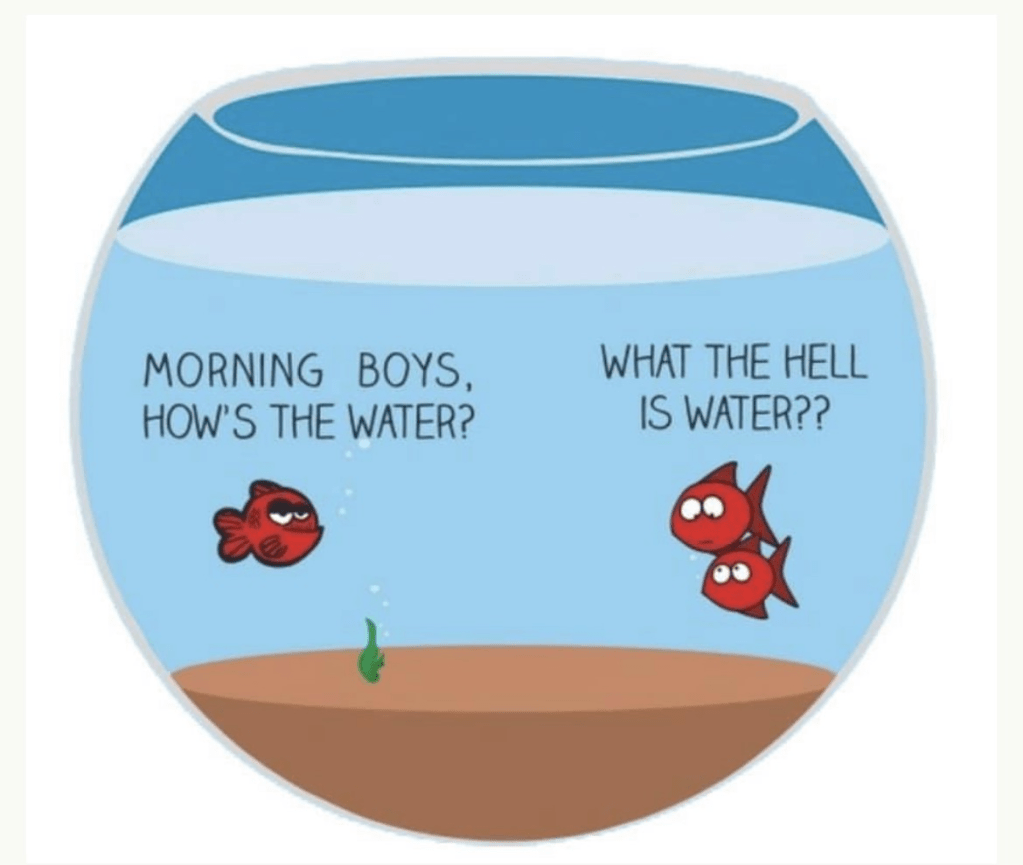
The challenge around knowing the conditions (with any sort of accuracy) is that leaders are often IN the conditions.  See the fish in water analogy below.

How might a leader step outside of this to gauge a school’s readiness for a new initiatives or to consider what approach is required given the current conditions? 

  1. Leaders may want to moderate their own judgements with those outside the immediate vicinity of the school. This relies on having a support network beyond the school itself and having the ability to put aside one’s ‘ego’ and accept that ‘we don’t know what we don’t know’. This is true of us all, at any level. By actively moderating one’s own judgement of what best practice is we send a clear message to those we lead- we ALL need to be collegiate, collaborative and continuously improving. After all, this is the nature of the business we’re in as educators!
  2. Leaders may wish to collate information through various formal/informal diagnostics. The aim of the game is to have enough evidence to support your ‘claim’. E.g. collecting survey data, informal discussion and outcomes in Writing books are telling me that we need to review/rethink the efficacy of our writing curriculum
  3. Leaders may also wish to engage in some thought experiments and decide what the response might be to any given initiative, given the current climate or ‘mood’ within the school. This is not to say that this will wholly dictate the decision making about implementation but in knowing this, we can put in place mechanisms to succeed and fail-safes (a Plan B if all goes terribly wrong!)

Sometimes, the conditions may not be at all optimal for an implementation effort but the benefits that the initiative would have on pupil outcomes and the quality of education may outweigh the decision to halt implementation altogether. In these very challenging contexts, it’s crucial for leaders to consider HOW they implement, at a granular level, at each stage. In this case, establishing a clear vision of what success looks like and ensuring a truly experienced small-win can support with building enough momentum.

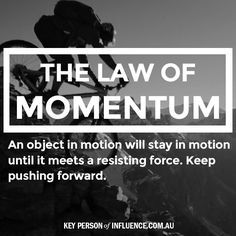
Anticipating and responding quickly to resisting forces can support with maintaining momentum at all costs, until the benefits of the initiative can be more securely felt and experienced. Leaders play an important role in this notion of success being ‘felt and experienced’ by those they lead. How are we positively reinforcing the behaviour changes that have led to this win? How are we highlighting this as a key milestone for success? How can we take this and build on it? These are all questions that can be reflected upon as leaders navigate this challenging terrain.

An Awareness of the Important of Communication…

Conditions and culture within our teams are inextricably related. Because culture often feels intangible and abstract as a concept, we can sometimes forget as leaders that culture is created through the small, daily interactions we have with our teams, as well as the larger, more strategic strategies to develop a strong school culture.

The most powerful thing the pilot did (outside his core business of landing us safely) that we experienced on our end, was the manner with which he communicated his updates. Now of course, on his end, this was not his primary concern and the technicalities and decision-making processes he was engaging with was most definitely occupying most of his headspace! However, as the recipient of his ‘leadership’, that’s the bit I remembered.

Communication is often misinterpreted as ‘purely positive and lovely communication’. This is not the case. Sometimes difficult messages need to be delivered. A combination of domain-specific knowledge, responsive problem-solving and our ability to communicate tricky messages, frame challenge and offer candid feedback makes for truly great leadership, that makes a difference on the ground.

But how we communicate can again, be difficult to gauge because we’re unable to experience our own communication and how it lands with others. What might a leader do to support awareness of their professional practice and the strengths and opportunities for growth?

  1. Leaders might ask a critical friend. Someone we know will give it to us straight and tell us if our communication isn’t perhaps landing in the way we intend it to.
  2. Leaders might film themselves delivering a session and in the same way video footage is used to support teacher development, consider what small action step is the highest leverage in terms of evolving their ways of working
  3. Leaders might intentionally observe another leader and consider their communication and how it may contribute to the wider culture/conditions within their school. We’re often better at picking out the actions steps for others than considering our own but if we can then bring this back to reflecting on a particular aspect of our comms this can work really well!

All of the above can often feel extra uncomfortable for a leader because it involves a level of vulnerability which is not typically a leadership-associated trait. But within the vulnerability is an opportunity for growth and innovation.

A Responsive Approach to Problem -Solving

There will always be a discrepancy between an intended and enacted implementation effort (much like an intended and enacted curriculum). Our role as leaders is to a) have a clear and evidence-informed mental model of what the intended vision is b) to reduce the gap between this and the enacted delivery.

Roadblocks are inevitable in a ‘living, breathing, school’ and as leaders we have to accept, not fight this. So what does being responsive involve? The same things it involves to be responsive as a teacher in the classroom.

  1. Robust formative ‘data’ (scary word for information)
  2. Quickly adapting implementation where neccesary in response to this formative data
  3. Regular checks against the overarching ‘benchmark of brilliance’ (in other words, ‘the dream’ or ‘what this would look like in 6-12 months time if everything went to plan!)

Not to sound like a broken record, but this too, in my humble opinion comes back to creating a culture of continuous improvement where it is EXPECTED to go wrong at points but it’s also EXPECTED that we ‘hold our nerve’ (shout out to Lauren Meadows for this mantra), adapt and continue down our chosen paths.

Ideally, we want to aim to mitigate against roadblocks as much as possible so that time and space can be dedicated to truly immersing ourself in new practice. And this involves deep-thinking about the finer details…

If we spend enough time in our explore and prepare phase (EEF Implementation Guidance), we can a) start building a culture of ‘fast forwarding’ and ‘slowing down’ to adjust practice b) reduce the likelihood our implementation efforts will fail entirely, which is a loss of resource, funding and most importantly time.

Slowing down and playing the long-game is very much an art form (one which I’m yet to master as a leader myself!) The best way to summarise it? I’ll leave it to this literary legend…