From Command to Conversation: Harnessing Collective Wisdom in Schools

I recently came across a thought-provoking blog by Nimish Lad on leadership as an attentional practice (link here- https://researcherteacher.home.blog/2025/08/17/leadership-as-an-attentional-practice/)  He writes:

“I am reminded of the phrase ‘you don’t know what you don’t know.’ While reflecting on your own practice is important, it may be more important to seek out the views of others to feedback on what you may not be paying enough attention to.”

That struck me. Leadership, especially in schools, is so often framed as an individual pursuit. We instinctively look for the expert, the decision-maker, the one with the answers. That’s what leaders are for, right?

Traditionally, leadership has been about evaluating the state of play, setting the direction and charting the course. But that model carries an inherent risk: important decisions get made in isolation. When just one or two people make a call, it is inevitably shaped by their assumptions, beliefs, values, and knowledge base.

“But they’re the experts,” you might say. “It’s their job to decide.” Perhaps. But as Chi, Glaser, and Farr (1988) remind us: ‘Experts excel mainly in their own domains.’ And even within those domains, expertise is not simply the product of innate talent or accumulated experience. As Ericsson & Ward (2007) define it expertise is: ‘Consistent, superior performance on key tasks, achieved through long-term, structured practice that transforms cognitive and physiological capabilities.’

That’s invaluable when specific knowledge is needed, but much less helpful when tackling complex, school-wide challenges that cut across multiple areas and perspectives. Take, for example, the challenge of improving literacy. While it might seem like the responsibility of the English Lead or Head of English alone, it also falls to the Geography Lead, the Science Lead, and even the Personal Development Lead to address this priority. In these cross-cutting areas, the expertise of each subject leader must be acknowledged and respected. At the same time, pooling this specialised knowledge allows teams to address broader priorities collaboratively, ensuring that decisions benefit from both deep expertise and the diverse perspectives needed for school-wide improvement.

This is where leadership must expand beyond the boundaries of individual expertise. It means stepping outside your own lens of what needs to be done to collaborate on solutions that serve both your area and wider improvement priorities.

Consider another example: senior leaders setting strategic priorities for the year ahead. Say a leader identifies Mathematics as a key area for development. That decision may well have come from deep analysis, looking at assessment data, classroom practice, and work scrutiny. But even then, it’s one person’s interpretation of that evidence, inevitably shaped by their biases, preferences, and prior experience. As Adam Grant puts it: ‘If knowledge is power, knowing what we don’t know is wisdom.’ (Grant, 2021)

In medicine, high-stakes, complex decision-making is often handled through multidisciplinary teams. These are groups of professionals from different specialties who come together to make decisions for a single patient. The structure of this model is worth examining:

  • Expertise is shared across disciplines to make more informed decisions.
  • The significance of the decision is explicitly acknowledged.
  • Key data and evidence are shared in advance, so everyone comes prepared.
  • Deliberate discussion considers risks, benefits, ethical implications, and patient preferences.
  • A clear decision is recorded, with a plan for review.

This approach has been shown to promote meaningful collaboration across disciplines and ultimately improve patient outcomes. A 2023 meta-analysis found that interprofessional learning within multidisciplinary teams (MDTs) led to a 23% reduction in treatment-related complications compared to standard care (Reeves et al., 2023).

Of course, none of this is to dismiss the importance of expertise, practicality, or accountability. There are moments when swift, decisive leadership is essential, and times when the responsibility cannot be shared. The buck still stops with the headteacher or senior leader. Nor is it realistic to suggest that schools, already stretched for time, can replicate the full structures of multidisciplinary teams in medicine. The point is not to abandon expertise or delay action, but to balance it: recognising where a leader’s specialist knowledge should guide the way, and where opening the conversation to others can surface blind spots, enrich perspectives, and ultimately lead to wiser decisions.

We’ve seen versions of this approach adopted in education already, in pupil progress meetings or in a pastoral context where multiple agencies come together to consider how best to support a pupil e.g. team around the family. But what if we used this model more intentionally not just for intervention, but to guide strategic decision making as leaders?

What if we made space for genuinely shared sense making, where knowledge is pooled, perspectives are challenged, and blind spots are surfaced before they become missteps? Perhaps leadership is less about having the answers, and more about creating the conditions for better questions and wiser decisions to emerge.

References

  • Chi, M. T. H., Glaser, R., & Farr, M. J. (1988). The nature of expertise. Hillsdale, NJ: Lawrence Erlbaum Associates.
  • Ericsson, K. A., & Ward, P. (2007). Capturing the naturally occurring superior performance of experts in the laboratory: Toward a science of expert and exceptional performance. Current Directions in Psychological Science, 16(6), 346–350. https://doi.org/10.1111/j.1467-8721.2007.00533.x
  • Grant, A. (2021). Think again: The power of knowing what you don’t know. Viking.
  • Reeves, S., Xyrichis, A., Zwarenstein, M., & et al. (2023). The effectiveness of interprofessional teams: A meta-analysis. Journal of Interprofessional Care, 37(2)
Disagreeing with Grace

Exercise can feel uncomfortable, unpleasant, and sometimes impossible. But as adults, we know avoiding it only leads to more problems later.

Now, let’s reframe that…

Disagreement can also feel uncomfortable, unpleasant and yes, sometimes impossible! However, while not every disagreement leads to positive outcomes, as school leaders, we recognise that avoiding honest conversations can often cost us far more in the long term: strained relationships, stagnation, and decisions made without the benefit of diverse perspectives.

Charlan Nemeth’s research into group dynamics and dissent, spanning from the 1970s to the 1990s, found that disagreement isn’t just helpful, it’s essential in many contexts. It encourages divergent thinking, improved idea generation and deeper analysis. 

Her work also revealed something important for team discussions in schools: authentic disagreement (genuinely held opposing views) is far more effective than someone simply ‘playing devil’s advocate.’ This relies on a level of psychological safety that teams may lack. The conditions for such candour must be deliberately built for colleagues to feel genuinely safe when speaking up.

Of course, speaking up, especially when you’re the dissenting voice, can be daunting. As Stone and Heen note in Thanks for the Feedback, receiving feedback of any kind sits at the intersection of our ‘drive to learn and longing for acceptance.’ The same is true for giving feedback, particularly when it goes against the grain of group consensus or tradition. However, without that all-important psychological safety, dissent often alienates rather than drives constructive dialogue. In short-it’s a delicate challenge.

In school settings, staff may hold back from challenging a popular opinion, not because they lack ideas, but because they worry about how they’ll be perceived. Yet Nemeth’s work shows that minority views, even when quiet, have a lingering impact. They shape decisions subtly and over time. This challenges the idea that power rests with a small group at the top, questioning hierarchical models that keep it there.

Power and the School Staffroom

In schools, as in any organisation, power dynamics shape who feels safe to speak and whose ideas carry weight.

The Social Alignment Theory of Power (Fast et al., 2002) explains that people adapt their behaviour depending on how much influence they believe they have. In a school setting, this might mean that a newly qualified teacher stays quiet in a meeting, while a long-serving SLT member speaks freely. These dynamics are often unspoken but deeply felt and as leaders, we must pay attention.

Three Responsibilities for School Leaders

  1. Notice the dynamics in your team.
    Who’s speaking? Who’s staying silent? And why? Pay attention to participation patterns in meetings and informal settings.
  2. Use your influence purposefully.
    Leadership isn’t just about being the loudest voice or final decision-maker. It’s about creating conditions where others can contribute confidently even (especially) when they disagree.
  3. Distribute power deliberately.
    Share responsibility. Rotate facilitation roles. Encourage staff to lead discussions or initiatives. Small structural changes can foster big shifts in confidence and agency.

A meta-analysis by Schaerer et al. (2020) found that while power can help individuals achieve their own goals, it often gets in the way of collective progress. Most school leaders won’t need academic data to recognise this; many have experienced the impact of a leader who dominates rather than fostering collaboration. 

From Theory to Practice: Disagreeing Well in Schools

We’ve established that:

  • Disagreement can be valuable in certain contexts.
  • How we disagree matters.
  • Power dynamics influence who feels free to disagree.

So how can school leaders build cultures where disagreement isn’t feared but welcomed?

1. Don’t Play Devil’s Advocate

Rather than performing opposition, express genuine thought. Try this:

“I think I disagree on this one…”

This phrasing balances humility, honesty, and specificity:

  • “I think” suggests openness.
  • “I disagree” is clear and respectful.
  • “On this one” signals that you’re not oppositional by nature, just thoughtful in this moment. 

2. Level the Playing Field in Team Meetings

It’s hard to remove hierarchy entirely but you can reduce its impact:

  • Ensure all voices are heard, not just the confident or senior ones.
  • Gently invite contributions from quieter team members.
  • Rotate who leads meetings or shares reflections.
  • Avoid symbolic power positions, like always sitting at the “top” of the table.

3. Pick a Lane and Be Honest About It

Leadership in schools involves an acknowledgement of power dynamics. Ask yourself:
Are you leading for your own advancement, or for something greater?
Progress for yourself and your community are not mutually exclusive. Effective school leadership requires balancing your own professional growth with the broader needs of the school, ensuring personal development strengthens collective progress. But how you balance those motivations and how they show up in your interactions matters deeply.

Practical Ways to Disagree with Grace in Education

Disagreeing with grace isn’t just about research or reflection. It’s about our daily practice in staffrooms, classrooms, and leadership conversations. Here are a few grounded reminders:

  1. Match the medium to the message.
    If you’re raising disagreement online or via email, be respectful. Tone is easily lost, and sarcasm rarely wins people over. 
  2. Stay open.
    Avoid gatekeeping. Resist the temptation of the echo chamber. Good ideas can come from anywhere: new staff, different departments, or external voices.
  3. Allow people space to grow.
    Give colleagues the grace to change their minds. We’re all learning. Assume good intent and leave room for development.
  4. Model politeness.
    It’s easy to overlook, but manners still matter. Courtesy builds trust and trust builds better teams.

Disagreeing in school leadership isn’t always comfortable, but it’s necessary. Like exercise, the discomfort is part of the growth. Avoiding it doesn’t make it go away. It just makes the problems grow in silence. Because in leadership, unchecked power can quickly turn into pique and that can quietly undermine the very purpose of what we’re here to do: lead learning, lead people, and lead with integrity.

The Importance of Language: Framing Professional Conversations

Finally, it’s worth reflecting on the language we use around conflict and conversation. The word ‘disagreement’ can sometimes carry connotations of opposition or conflict, which might unintentionally discourage open dialogue. Instead, terms like ‘debate,’ ‘professional discourse,’ or ‘collaborative inquiry’ might better capture the spirit of constructive and respectful exploration of ideas that we want to cultivate in education. Debate is a skill. It is rooted in respect, evidence, and active listening that can be developed and valued across the sector. By framing our conversations this way, we encourage a culture where diverse ideas are rigorously but respectfully examined, supporting continuous learning and fostering a culture of growth, not division.

‘Why are we doing this anyway?’ A framework for establishing, evaluating and exploring our purpose.

Purpose is the intentional and guiding principle that connects what we do to why it matters.

Greek philosophers often discussed the concept of ‘purpose’ using the term ‘telos’ (τέλος) which means end goal or purpose. Aristotle articulated this through his theory of four causes: material, formal, efficient and final. The final purpose being the ultimate end goal e.g. an acorn becoming an oak tree. Plato believed the highest purpose of human life was the pursuit of truth and wisdom. And for the Stoics, purpose was all about living in alignment with nature and reason.

Purpose in the context of organisations and more specifically in the realm of school improvement is also not a new concept. Very few school leaders would argue against the need for clarity of purpose in their improvement efforts and we already see the word ‘purpose’ in multiple ways in our schools. For example:

-purpose of study in National Curriculum guidance

-purpose statements for trusts or individual schools

-purpose of improvement initiatives or strategic moves

I’ve been thinking a lot about purpose recently. Personally, in a more existential way and professionally in a bid to consider the more practical ways educational leaders can work with the knotty, complex and yet, beautifully simple ‘texture’ of purpose as a concept. Simon Sinek’s more recent work ‘Start with Why’ has popularised a long-held tradition of leaders deeply considering the ‘why’ of what they do, with a focus on accurately articulating and rooting their work in this ‘why’. Dr Houman Hourani (Harvard Graduate School of Education), talks about how those we lead may well ask the question ‘why do we need to do this?’ and how this is often interpreted as whining or expected discontent in the face of change. He argues however that we as leaders must be able to confidently answer this question and in his words ‘move more seamlessly between purpose and task, task and purpose.’

My thinking on this topic has led me to put together the beginnings of a framework for leaders at all levels to more practically consider their purpose through meaningful dialogue. Whether they are doing the exciting work of establishing a purpose or whether they are coming back to their purpose and evaluating the extent to which it is being fulfilled, I hope this framework serves as a useful way to structure conversations. Below is my ‘I CAN’ framework for exploring purpose. The framework might be applied in: school-wide conversations about orientation and direction of travel, departmental meetings more tightly rooted in the purpose of individual subjects or strategic conversations about the purpose of change initiatives.

Please note that the framework is in it’s first draft and I’m keen to get the conversation going about the ways it can be refined, to become a practical reflective tool for school leaders. This time of the year felt like an apt time to share the framework in the spirit of collaboration and I do hope it sees multiple iterations in the coming weeks and months, reflective of practitioners who are engaging in the important business of exploring purpose in our schools. (PDF below)

The Leadership Development Challenge- it’s time to Get Real

As a leader who has spent much of the last decade designing, implementing and refining curricular across different contexts and on different scales, I have been deeply encouraged by the tone and tenor of the recent curriculum and assessment review which we have seen unfold over the past few months. The way in which collective knowledge is being pooled, the transparency of the process itself and the way in which findings have emerged and been communicated are all markers of great change management by truly great leaders within their own right.

Recently however, this reflection prompted a thought…much of the quality of curricular evolution of any kind, is determined by the manner in which it is navigated, implemented, refined and ultimately, led. And this thought led me to another…without the necessary skill, knowledge and actionable expertise, leaders are left with potentially shifting sands, the requirement for change and little by way of professional support, guidance and development to help them achieve this successfully.

Educational leaders have an incredibly difficult challenge on their hands when it comes to developing and strengthening their curriculum offers:

  1. the work they do is never done and therefore can be challenging to frame in a ‘get it done’ ‘to-do-list’ culture.
  2. the work is nestled in a complex, relational ecosystem which, if unbalanced, compromises the very core business of learning and teaching and the longevity of implementation
  3. they carry out this work, largely in isolation and when networks do exist, the culture (unwittingly and even in the most well-intentioned places!) is sometimes one of competition, rather than collaboration

And this isn’t limited to curriculum development! In every domain of leadership, these barriers exist. I would argue that in the wake of less readily funded NPQs and an undeniable level of variability in leadership development entitlement for school leaders nationally, there is a vacuum that must be filled.

I’ve pondered over the potential solution to this challenge deeply over the past few years. Beyond the knowledge contained in the NPQs how best can leaders be supported to:

-move from domain specific knowledge to effective professional practice

-supplement their domain specific knowledge with the knowledge of how to achieve the right conditions within the teams they lead (as a necessary prerequisite to sustained school improvement)

-tackle the recruitment and retention crisis upstream by shifting to a dual focus on the ‘what’ and the ‘how’ of school improvement

If you’ve read up to this point in the blog, I’m sorry to say I don’t yet have an answer. But a few colleagues of mine (the formidable duo Sarah Cottinghatt and Nimish Lad) have been thinking deeply about this, with the support of our dear mentor, Oli Caviglioli.

We’ve been fascinated by the notion of ‘Naturalistic Decision Making’ (Klein 2014) and spent many hours considering how we help leaders ‘on the court’ and ‘in the moment’ with real life situations that happen in real schools (that quite often we don’t really discuss widely for many reasons!) Not in vignettes or scenarios that avoid the messy stuff of school leadership. In ones that capture the real nuance and allow leaders to discuss solutions, collectively, in a low stakes way.

That’s when we came up with the idea for Get Real Leadership Hub. A community-led platform, where realistic school scenarios are released fortnightly and educational leaders have a chance to respectfully debate, discuss and sensemake. We will share useful links, reading and expert opinions related to the scenario and empower leaders to think deeply about implementation, in a way they might not otherwise be able to. It’s all free, it’s not overly shiny, and it’s generated by the collective knowledge of leaders in the sector. There are also no ‘right answers’ to the scenario. It’s not about getting to the answer, it’s about how you find the solution (hat tip to all my maths teachers out there!)

It’s certainly not the finished product but we work on a simple premise:

‘Do the best you can until you know better. Then when you know better, do better’ Maya Angelou.

And even if one leader in the sector benefits from GetReal, we will consider it a job well done. Please follow us on X and Bluesky and be part of the solution, the conversation and the community. It’s time to Get Real.

Communication- let’s talk about it

As leaders, we spend a lot of time communicating. Communicating our thoughts. Communicating our feedback. Communicating our relative position on a charted course. Communicating makes up so much of what we do. As school leaders, we work in complex environments that are demanding, unrelenting and require constant communication. Yet, there is little, or no training provided to school leaders on how to get this aspect of leadership right. Instead, we form representations of great communication in our mind; an amalgamation of great and not so great communicators that we’ve experienced and rely on these to help us craft our messages.

The challenge for us leaders is that we often adopt ‘approaches’ to communication that become a trademark of our ways of working. Why might this be problematic? If our mental representation of great communication is ill-informed or if we don’t intentionally set norms around the way we communicate in our teams, we may have an unhelpful reputation on our hands…Introducing…

The truth teller: the leader who tells the excruciating truth with very direct use of language every single time. You know where you stand but you’re not left standing…you’re left crushed…into a former shadow of your professional self, questioning your value as a human being. Psychological safety might be easier to achieve with this leader at the helm because they are so transparent, but it also might be harder because their direct-ness is intimidating and shuts others down.

The nice leader: this nice leader is beloved by all. They are easy to talk to and fun to be around, but they prize being liked over everything else. Because of this, you’re not quite sure that what you’re getting is an accurate view of what they truly think. Trust might be more easily achieved with this leader from a relational standpoint but less so from a competency-standpoint. Do I trust this leader to point out my strengths? YES. Do I trust them to tell me the truth about the real state of play? Not so much.

The dresser up of the truth: this leader uses beautiful and flowery language to dress things up. It sounds kind of wonderful but a dark feeling in the pit of your stomach tells you it’s anything but wonderful. Communication may not seem particularly authentic because it’s had so much ‘work done to it’. Once this happens a few times and we recognise this as a pattern of communication, we may shut down entirely for future interactions.

The overwhelmed leader: this leader is deeply caring but every conversation appears to evoke a sense of panic in them which in turn evokes panic in you. You are ultra-aware of this leader’s workload and therefore upward empathy is well-established. The downside of this, is that people tend to avoid conversations with them altogether, as to not stress them out.

The four above caricatures of leaders are just that- fairly exaggerated caricatures from the point of view of colleagues in these leaders’ teams. There is also no judgement of these caricatures- it’s likely that as leaders, we’ve all played these parts at some point (I know I have!!). But they do remind us of a few important things:

  1. Choices we make around the way we communicate come with pros and cons. There’s never a ‘right’ way to do it and context is everything. We may, in certain situations, for example NEED to be ‘the truth teller’. It’s not clear-cut, it’s incredibly nuanced and there’s no ‘educational best bets’ to lean back on around communication- much of this relies on instinct and having experienced or seen good models of communication before.
  2. Choices we make around how we communicate can very easily morph into these caricature trademarks, which can inadvertently impact our leadership efforts. Being more aware of how we’re communicating and the impact this has on those we lead, is our best bet.
  3. Recognising that our intentions may be at odds with how our message or story lands for the recipient is crucial.

What communication?

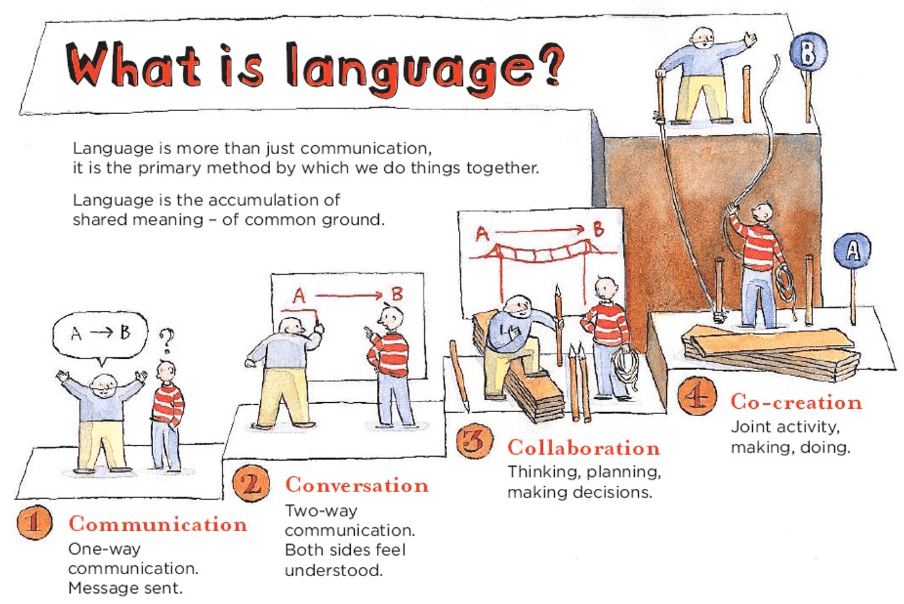
So how might leaders support themselves in crafting their message? To begin with it’s important to boil it down to, as Dave Gray calls it, ‘the primary method by which we do things together’- language. What can language be used for?

  1. Communication
  2. Conversation
  3. Collaboration
  4. Co-creation

By first, identifying the purpose of what we’re doing together, we can begin to consider the ways in which we might use language to fulfil these purposes.

Language for Communication

Language for collaboration will look markedly different to language for co-creation. Language for collaboration, for example, will be far more tentative, flexible, and fluid. A specific example? Modal verbs will be far more present in our vernacular. ‘This might be the way forward…’ ‘We may need to explore the different approaches further.’

Language for communication, where a message needs to be transmitted from A-B will look slightly different- it will be direct, with imperative verbs, economy of language and crisp clarity. Short prose, with key headlines work very well for this type of communication and in the best-case scenario, there is very little room for interpretation. (NB- also worth noting the visual above and the clarity it brings to this conceptualisation, as a means of communicating an idea).

Language choices (down to the word) can make an incredible difference to the way a message is interpreted. For example, saying ‘I need this from you by next Tuesday…’ is experienced entirely different to ‘We need to achieve this by next Tuesday. The expectation is that…’ When scripting an email, it feels doable for us to consider our language choices carefully, but this becomes much trickier in spontaneous communication e.g. a conversation. During these types of communication, leaders have to be far more responsive and rely on their instincts to recognise the ‘mood’ of the conversation. Again, there isn’t necessarily a formula for getting these spontaneous conversations ‘right’, but it may be useful to be aware of the below model, developed by Padensky (1995). This hot cross bun model, typically used in the context of clinical psychology, very helpfully highlights the interplay between individuals’ thoughts, feelings, behaviours, and physical feelings. Recognising the relationship between these, can potentially support leaders in truly unearthing people’s perspectives enabling them to truly see and hear those they lead. As Peter Drucker, quite aptly puts it: ‘The most important thing in communication is to hear what isn’t being said’ Peter Drucker

Communication for Professional Learning

Effective communication is also essential when designing and delivering CPD of any kind. Matt Abrahams, lecturer on communication at Stanford Graduate School of Business, offers some useful guidance on how best we can communicate during any form of presentation. He encourages speakers to:

  1. Help their audience feel comfortable by mastering one’s own anxiety. How? By recognising it, acknowledging it, and accepting that it’s something we ALL feel. This alone can minimise the impact that this undoubtedly has on us when addressing a room.
  2. Reframing your view of things by moving away from ‘trying to get it right’ towards ‘having a conversation’. By doing so, we shift the dynamic in the room away from transmission of information to an interactive conversation. From didactic to dialogic. From being told to collectively learning.
  3.  By opening with a question to invite the audience into the ‘conversation’.
  4. Abrahams suggests structuring your presentation as an answer to a list of questions to again, move towards the dialogic.
  5. He also encourages speakers to be hyper-vigilant about the language that they use and to keep it simple. He encourages speakers to opt for simple language that unites, rather than language that creates a distance between the speaker and audience.

When crafting professional learning, we therefore may want to consider the following questions:

  1. What will my audience know at the end of the session that they didn’t before? Limit this to 1-3 things as not to cognitively overload our audience.
  2. What terms will I use? When will I define those terms?
  3. Why is this important for them to know? How will it impact them day-to-day?
  4. How will my audience feel when they leave this session?
  5. How will I involve my audience in the conversation?

Communication, like school culture, is messy, knotty, and heavily context considerate. It varies from person-to-person and situation-to-situation. Because of that, it can sometimes be scary to focus on this, amongst the billion other things leaders need to focus on. I would argue however, that it’s in the very small interactions of a few sentences or words, that trust and psychological safety are built. If we as leaders can accept that we won’t always get it right and be at peace with this, we can perhaps open up a conversation about what good communication does look like in our contexts. Perhaps by creating norms with other leaders, we can create a safe, consistent drumbeat of interaction within our teams, laying the foundation for a work environment that feels calm and consistent, where people feel truly seen and heard and where there is a deep and enduring sense of community.

Link for further exploration: